Information Technology
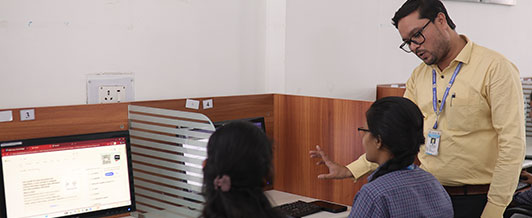
The Department of Information Technology is one of the pioneering department of the institutions. It provides strategic direction for the management of the information technology resources. These include telecommunications, data, and supporting physical infrastructure; application infrastructure, computer engineering and operations, data centers, servers, storage, and backup equipment; cloud services etc It is endowed with an experienced team of faculty members having excellent academic records and proficiency. It aims at uniting on one site with purpose-built facilities and the state-of- the-art computer labs with the latest advances in technology and comprehensive study material which helps to unlock the full potential of the students.
Teaching Scheme
Syllabus
Academic Calendar
Quick Links
VISION:
To foster Information Technology graduates by imparting quality technical education through need based technical skills with ethical values so that they can contribute to the society through excellence in scientific and knowledge-based education
MISSION:
- To empower emerging graduates with a blend of high-quality technical expertise and strong ethical values through our education.
- To achieve excellence in professional practice within Information Technology and its related fields.
- To inspire learners to conduct research that addresses societal needs.
- To imbibe ethical values in students and enhance societal engagement through extracurricular activities focused on addressing community needs.

Prof. Prashant S. Gumgaonkar
H.O.D. Information Technology
Contact No:- +91-8999816327
Email id:- prashantsg90@gmail.com
Qualification :- PhD (persuing), M-Tech, B.E
Teaching Experience : 16 Years
Industry Experience : Nil
From The Head Of The Department
Established in 2008, the Department of Information Technology at Govindrao Wanjari College of Engineering & Technology (GWCET), Nagpur is committed to providing quality technical education and fostering innovation, research, and professional excellence. The department offers a dynamic undergraduate programme with a curriculum aligned to NEP 2020 and industry requirements.
With experienced faculty, modern laboratories, project-based learning, internships, workshops, and industry interactions, the department equips students with the technical knowledge and practical skills required in emerging areas such as Artificial Intelligence, Data Science, Cyber Security, Cloud Computing, Internet of Things (IoT), and Software Development.
The department encourages students to participate in research, hackathons, technical competitions, and entrepreneurship activities, preparing them to become competent IT professionals, lifelong learners, and responsible contributors to society.
News & Updates
Prof. Prashant Gumgaonkar

Prof. Vandana S. Choubey

Prof. Shilpa Chindamwar

Prof. Prachiti Vilas Adghulkar
Prof Roger David

Prof Anagha Dharghawe

Prof Arvind Ganvir

Prof Shivam Butle
Programme Outcomes (PO’s)
PO1. Engineering Knowledge: Apply the knowledge of mathematics, science, engineering fundamentals, and an engineering specialization to the solution of complex engineering problems.
PO2. Problem Analysis: Identify, formulate, review research literature, and analyze complex engineering problems reaching substantiated conclusions using first principles of mathematics, natural sciences, and engineering sciences.
PO3. Design/development of solutions: Design solutions for complex engineering problems and design system components or processes that meet the specified needs with appropriate consideration for the public health and safety, and the cultural, societal, and environmental considerations.
PO4. Conduct investigations of complex problems: Use research-based knowledge and research methods including design of experiments, analysis and interpretation of data, and synthesis of the information to provide valid conclusions.
PO5. Modern tool usage: Create, select, and apply appropriate techniques, resources, and modern engineering and IT tools including prediction and modeling to complex engineering activities with an understanding of the limitations.
PO6. The engineer and society: Apply reasoning informed by the contextual knowledge to assess societal, health, safety, legal and cultural issues and the consequent responsibilities relevant to the professional engineering practice.
PO7. Environment and sustainability: Understand the impact of the professional engineering solutions in societal and environmental contexts, and demonstrate the knowledge of, and need for sustainable development.
PO8. Ethics: Apply ethical principles and commit to professional ethics and responsibilities and norms of the engineering practice.
PO9. Individual and team work: Function effectively as an individual, and as a member or leader in diverse teams, and in multidisciplinary settings.
PO10. Communication: Communicate effectively on complex engineering activities with the engineering community and with society at large, such as, being able to comprehend and write effective reports and design documentation, make effective presentations, and give and receive clear instructions.
PO11. Project management and finance: Demonstrate knowledge and understanding of the engineering and management principles and apply these to one’s own work, as a member and leader in a team, to manage projects and in multidisciplinary environments.
PO12. Life-long learning: Recognize the need for, and have the preparation and ability to engage in independent and life-long learning in the broadest context of technological change.
Programme Specific Objective (PSO’s)
- PSO1:Demonstrate skills in algorithm design, implementation, and applying current IT concepts and practices.
- PSO2:Apply knowledge to integrate IT solutions effectively into user environments.
Programme Educational Objectives (PEOs)
The Graduates of Computer Science & Engineering will be able to-
PEO1: Utilize cross-disciplinary knowledge in Information Technology for advanced studies, research, career readiness, product innovation, and tackling real-world challenges.
PEO2: IT graduates will be skilled in emerging technologies, teamwork, communication, and leadership.
PEO3: Academic excellence, innovation, soft skills, and ethical practices, alongside lifelong learning and awareness of current issues, drive professional success.
- Data Structure and Application Lab
- Design and Analysis of algorithm Lab
- Object Oriented Programming Lab
- Operating system Lab
- Project Lab
- Artificial Intelligence and Machine Learning Lab
- Database Management System Lab
- Intelligent Systems and Cloud Lab
| Sr. No. | MOU Signed with | Name of Representative | With effect from |
| 01 | Softbuzz Tech Pvt Ltd | Mr. Sharad Bansod | 07/05/2024 |
| 02 | Cluematrix Technologies Pvt Ltd | Mr. Hemant Barapatre | 22/03/2024 |
| 03 | NRSolution Pvt Ltd | Mr. Nilesh Gupta | 17/10/2023 |
| 04 | BLIINC Innovations Pvt Ltd | Mr. Nilesh Sahare | 09/09/2023 |
| 05 | Crescentweb Technology | Mr. Nikhil Raut | 06/10/2022 |
| 06 | Nexoya Soft Solutions | Mr. Mrunal Arjunkar | 01/08/2022 |